Getting started
The easiest bike bus is once a week
One predictable morning is enough to build a routine. Pick a day your adults can repeat, publish the schedule, and let the ride grow from there.
By Dennis, from Atlanta · 10 min read

If you are working out how often a bike bus should run, start with once a week. Same weekday, same route, same departure time.
Weekly is often enough that families remember it without being reminded, and rare enough that the adults are still doing it in February.
The short version
- Once a week, on the same weekday, at the same time.
- Pick the day two adults can actually repeat, not the day that sounds best.
- Publish the times and then keep them. Wheels move at the published minute.
- Growing does not mean adding days. It usually means adding stops, or a second line on the same morning.
- Add a second day only when the first one has stopped being interesting.
Why once a week is the right first answer
The instinct is to put every morning on the calendar. Families go to school five days a week, so why ride once?
Because each extra day multiplies the part that is actually hard, and the hard part was never the riding. It is finding two adults. Making the weather call at six in the morning. Answering the message from the family who is running late. Making sure somebody is still at the back of the group on the Friday your usual sweep has a work trip.
A weekly bike bus makes one small promise: this morning, this time, we ride together.
That is enough to change the shape of a week. Kids know which morning is bike bus morning. Parents know when to put the bikes by the door instead of moving them to get to the car. And an adult can protect one slot on their calendar without quietly signing up for a second job.
One trip a week can sound thin from the organizer's side. From a seven-year-old's side it is a standing appointment with their friends that happens before the bell.
The two guides most organizers start from land in the same place. Bike Bus World tells you to start small, establish a routine, and run once per week before you think about expanding. BikePGH puts it as a schedule question and then says the thing that matters: a regular schedule is key to participation.
Weekly is not the beginner version
It would be easy to read "start weekly" as the training-wheels option you outgrow. The bike buses people write news stories about are weekly.
In Montclair, New Jersey, a Friday ride that started three years ago with a few families now moves more than 350 children and adults. Still Friday.
Poe Elementary in Houston is the one I would actually study, because of how it grew. Parents and BikeHouston launched it late in one school year and brought it back when school resumed. It now runs two Friday morning lines, with about two dozen kids riding roughly a mile per route.
Two lines. One morning.
That is the whole argument in one example. When a bike bus outgrows itself, the fix is usually not another day. It is another stop, a second line on the same morning, or a route that starts further out. Bike Bus World says the same when it describes expanding: a longer route, more meeting points. Not more mornings.
Size and frequency are separate decisions, and people conflate them constantly. Forty riders on a Friday is a bigger bike bus than eight riders on a Tuesday and a Thursday, and it is less work.
Which day
The best day is the one your adults can repeat. That is the entire rule.
Friday is popular, and for a decent reason: it is easy to remember, easy to name, and it lands where a school week wants a small celebration anyway. But there is nothing magic about it, and choosing Friday because other bike buses did is how you end up fighting your own school's calendar. Sports, shift work, custody arrangements, and early-dismissal days all beat tradition.
Four questions worth asking before you commit:
- Which morning can a lead adult and a back adult both usually make?
- Does the school do something different that day, like a late start or an assembly?
- Will the usual gate, bike parking, and crossing guard be there?
- Who covers it when one of your two regulars cannot ride?
And do not rotate the day to catch more families. A bike bus on a different morning each week is not a routine, it is an event people have to rediscover. Pick the day that works well enough and then make it boring.
The schedule is the promise
A weekly ride only gets easy when nobody has to ask whether it is happening.
Put the weekday, the first departure, and every stop time in one place a parent can find without scrolling a group chat. If the first stop says 7:18, the group leaves at 7:18. A family who is late meets it at the next stop, which works as long as everybody knows which stop that is and an adult is going to be standing at it. That sounds strict and it is the opposite: keeping the time is what lets somebody plan around you.
Keep the route steady for the same reason. If construction closes your street or a better one opens up, change it deliberately and tell people first. BikePGH suggests giving more than 24 hours notice on a route or schedule change, which is about right, because the alternative is a family standing on a corner the group is not coming to.
Cancellations are the same shape. Decide who makes the call, what actually cancels a ride, and by what time it gets posted. The weather call goes into that properly. The one rule: families need the answer early enough to do something else.
Two adults who know the plan
For a small group the usual arrangement is one adult leading and one at the back. How many you actually need depends on your riders, your streets, and the rules where you live.
What matters for a weekly ride is that more than one person knows how it works. Put the dates on the volunteers' calendars weeks ahead. Name who leads and who sweeps for each one. Find one person who can step in when somebody wakes up sick.
This is a much easier ask once a week than every morning. "Can you take the second Friday this month?" is a request a person can say yes to. "Can you be available whenever I cannot ride?" is not a request, it is a mood.
Let the school office know your normal day and roughly when you arrive. Talking to the school office covers what to tell them, which is less than most people assume.
When only three families turn up
Ride anyway.
The first few weeks are small. Attendance drops in the cold, after a school break, and the morning after any event that ran late. None of that means it is failing.
Three families have a route, a time, and a group, which is the whole definition. Three families is a bike bus makes the case at length. A small ride is also when you find out that one stop has nowhere to wait, that the hill takes longer than you thought, and which kid needs more room to get started.
A group that goes past the same corner every week persuades people. A sign-up sheet with thirty names on it does not, because nobody can see it.
Is once a month enough?
If once a month is the schedule you can actually keep, then yes.
It will feel more like a school event than a routine, and you will have to remind people before each one. That is a real cost. But a monthly ride that happens beats a weekly ride that gets called off half the time because no adult could lead it.
Name it accurately, though. "First Friday of the month" is a schedule. "Most Fridays" is a group chat.
If the monthly rides keep filling up and your volunteers want more, go weekly. Just do not announce it until the adults and the route are ready for the second date as well as the first.
When to add a day
Add one when the ride has become routine, not when it is going well. Those feel identical from the inside and they are not the same thing.
What to look for:
- It has run several weeks with no last-minute scrambling.
- More than one adult can lead, sweep, and handle the messages.
- Families are asking for the same second day, not five different ones.
- The route, the stop times, and the cancellation rule are written down.
- The new day has its own reliable adults, rather than the same tired person twice.
The test I would apply: could the second day survive the absence of whoever is proposing it? If not, keep the one you have and protect it.
Start with next week
Pick a weekday. Plan the route. Ask two families who live near you. Put the departure time somewhere everyone can find.
Then ride next week.
You do not need five mornings or a finished volunteer rota. You need to keep one small promise often enough that it stops being remarkable.
When you are ready, start a bike bus and publish your day, your route, your stops and your times on one page you can send to a parent. It is free. The organizer's guide covers the rest of the setup.
Questions organizers ask
How often should a school bike bus run?
Once a week is the right starting point for most groups. Frequent enough to become familiar, rare enough that volunteers can sustain it across a school year. Monthly works too, if that is the schedule you can genuinely keep.
Is Friday the best day?
Friday is common because it is memorable and feels like a small celebration. It is not universally best. Pick the morning when your adults, the school gate, and the bike parking are all reliably available.
Can a bike bus run every day?
It can, and a few do. A daily ride needs enough independent adult leadership that one illness or one work meeting does not cancel it. Start weekly and add days as each new day earns its own coverage.
How long should we wait before adding a second day?
There is no number of weeks. Wait until the first day runs without anybody organizing it at the last minute, and until the second day has adults of its own. Expansion should absorb demand, not double one volunteer's workload.
Sources
- Start a Bike Bus, Bike Bus World. Recommends starting small and running once per week before expanding the route or adding meeting points.
- How to Start a Bike Bus, BikePGH. Sets the schedule as a decision, gives weekly as the example, and notes that a regular schedule drives participation.
- Houston students pedal to school on a bike bus, Axios Houston, September 4, 2026. Poe Elementary's two Friday lines.
- From a few to more than 350, children and parents ride together to school as a bike bus, Associated Press, November 5, 2025. Montclair's weekly Friday ride.
How often a bike bus rides, and whether a given schedule suits your riders and your streets, is a decision for the families and organizers involved. SchoolBikeBus publishes what a group tells it; it does not inspect routes, supervise rides, or certify that any schedule is safe.
Start one at your school
Publishing your route and stops is free, and stays free.
More field notes
 Getting started
Write a bike bus announcement a parent can answer
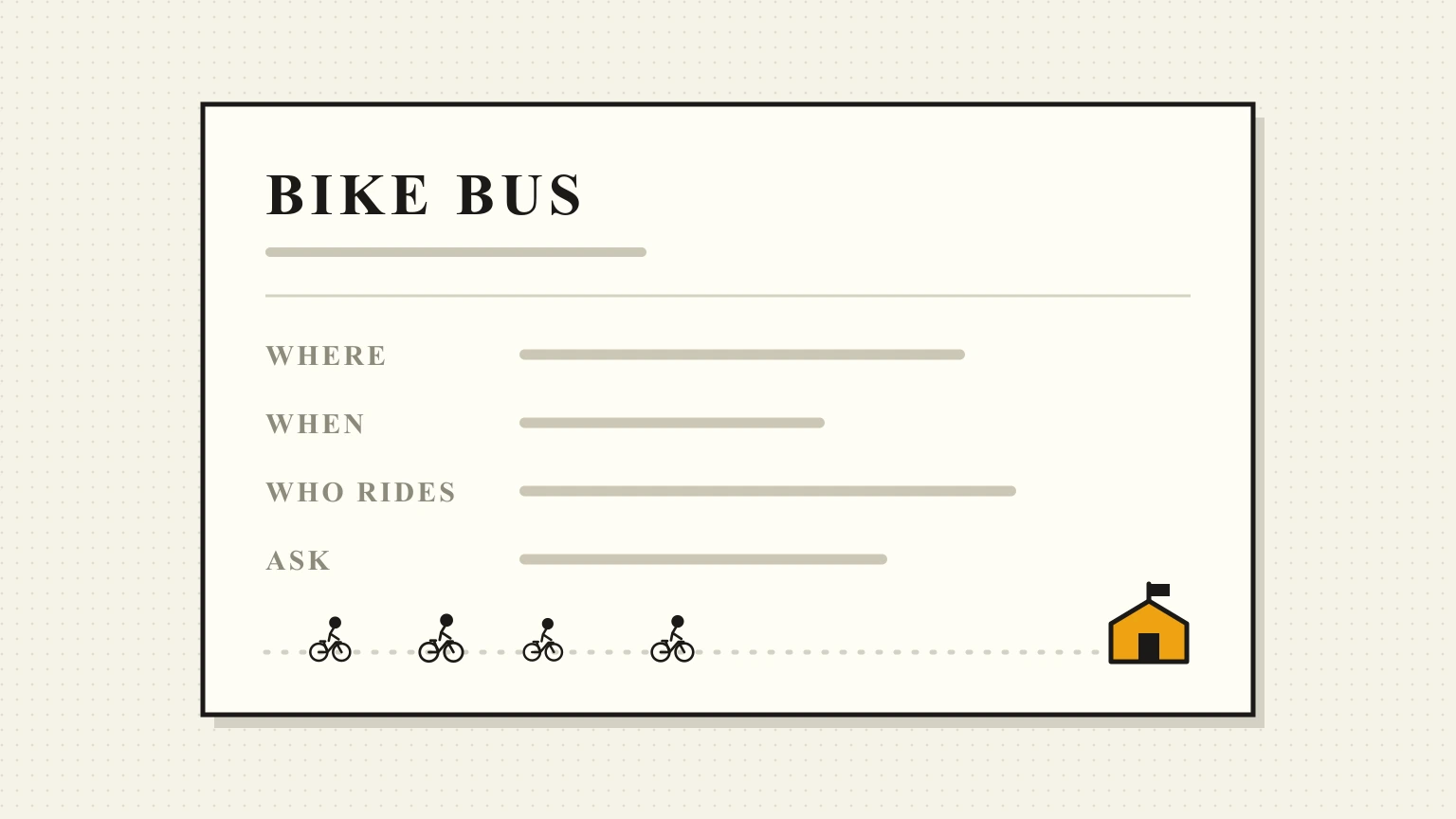
Before a family can say yes, they need the corner, the minute, whether a grown-up has to come, and who makes the weather call. The case for biking can wait.
10 min read
 Getting started
The PTA does not need to run the bike bus
A parent can lead the ride. The PTA can help families hear about it, find a couple of adults, and open the door to the school office, without taking on the whole thing.
9 min read
 Routes
How to plan a school bike bus route
The shortest route is rarely the best one. Build a route the least-confident rider can repeat, with stops and times families can actually understand.
11 min read