Getting started
Write a bike bus announcement a parent can answer
Before a family can say yes, they need the corner, the minute, whether a grown-up has to come, and who makes the weather call. The case for biking can wait.
By Dennis, from Atlanta · 10 min read
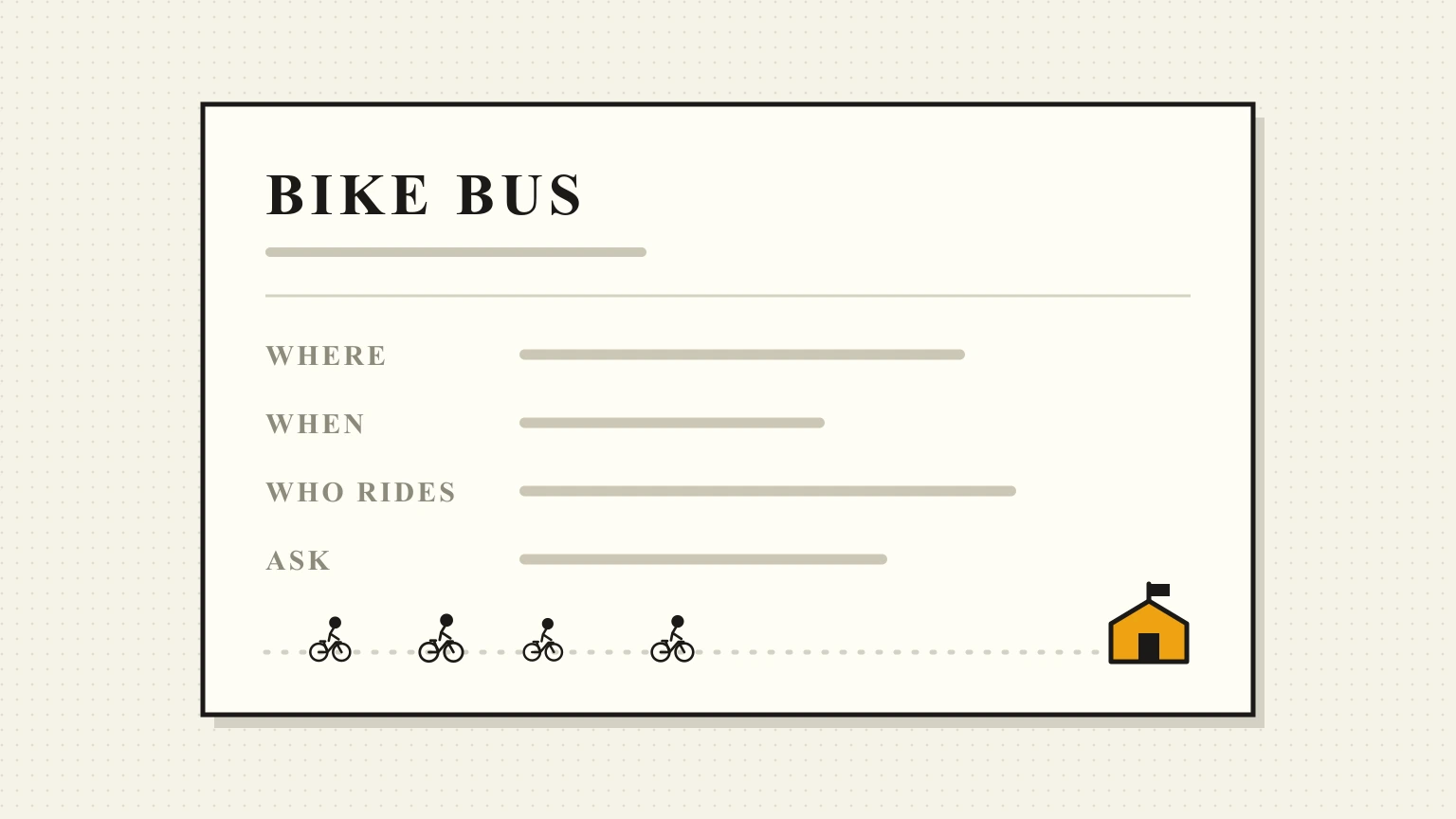
To announce a bike bus, give families four things before you invite them to anything: where the group meets and at what minute, where it goes and roughly when it gets there, whether a grown-up has to come along, and who to ask about the route. The invitation goes after those, not before.
A parent reading your message is not receiving news. They are working out whether Friday morning changes shape, and they are deciding in a kitchen, at speed, before their own day has started.
The short version
- Name the corner and the minute. "Near the school at 7:30" is not a meeting point.
- Say whether a grown-up has to ride along. This is the question that settles it for most families, and it is the one most announcements skip.
- Say who makes the weather call, by what time, and where it gets posted.
- Put one link in every channel, with the stops and times on it.
- Leave out the case for biking to school. Anyone who wants that can find it.
- Say plainly who is running the ride. A parent-organized group is not a school event.
The questions arrive in this order
From the parent side they come fast, and only one of them is about the bike bus.
Is that corner close enough that we are not driving to the bike ride. Is my kid ready for the crossing at the top of the hill. Can I still get to work afterward. And if it rains, how do I find out before I have gotten two children and two bikes out the door.
Three of those are about the family's morning. Your announcement cannot answer them, but it can give a parent enough to answer them without messaging you.
Here is the test I would use. Send the announcement, then count the replies. If the same question comes back from four different families, that answer belonged in the message. Most first announcements are not wrong. They are incomplete in the same three or four places every time, and the replies tell you which ones within a day.
Where and when, to the minute
Portland's Safe Routes to School guide puts these in a deliberate order: create a simple map of your route with information about when you'll meet, and then post about it and share the map. The map comes first because the announcement is mostly a pointer to it.
Name the actual corner, the park entrance, the shop, whatever a person can stand next to and be sure they are in the right place. "Near the school" sends somebody circling a block with a seven-year-old at 7:25 in the morning.
Then give the minute the group leaves, and say it is the minute the group leaves. Meeting time and departure time are different facts, and a family that has assumed they are the same arrives to watch the back of the ride. If your stops have their own times, put those on the page rather than in the message.
Whether a grown-up has to come
This is the line that decides it, and it is the one that goes missing.
Two families read "all welcome" and reach opposite conclusions. One packs a bike for themselves and rearranges a meeting. The other plans to wave their child off at the corner and drive to work. Both turn up on Friday having made a plan your announcement did not intend.
Portland's guide is specific about the adults who run the ride: two volunteers, one at the front and one at the back. That is a different question from whether each child needs a parent alongside, and your group has to answer the second one itself. It depends on your riders, your streets, and what the families involved are comfortable with.
Whatever you decide, write it as a sentence. "A grown-up rides with each child" is an answer. "Children who can already ride the route on their own are welcome without a parent" is an answer. "All ages welcome" is a mood.
The same guide lists what it expects riders to turn up with: a safe, well-fitted bike or scooter, a well-fitted helmet, and some practice riding in the street. If your group has expectations like those, they belong in the announcement rather than in a conversation on the first morning.
Four lines worth adding to a template
The recruitment message in the organizer's kit gives you the shape: a short version for a group chat and a longer one for a newsletter. It is deliberately brief, and there are four lines worth adding before you send either.
Who makes the weather call, by what time, and where. Not the rule itself, which can live on the page. The name, the deadline, and the channel. The weather call is about the rule; the announcement is about where a family will find the answer at 6:15.
What a late family does. Do you wait, or do wheels move at the published minute and the family meets you at the next stop. Either is fine. Not saying is how you get a parent chasing a moving group down a street with a child on a bike.
The adult rule. One sentence, in the message rather than in a reply to somebody who asked. It is the line that decides whether a family is in.
Who to ask about one specific crossing, privately. Some parent is going to have a question about the stretch of road nobody else worries about, and they will not ask it in a thread with forty people in it.
Compare a line most groups send with the same line carrying those:
A bike bus is starting at Thistlewood Elementary. We ride Friday mornings, leaving the corner of Hale and Third at 7:40. Route and stop times: [link]. Contact [name] to join.
A bike bus is starting at Thistlewood Elementary. We ride Friday mornings, leaving the corner of Hale and Third at 7:40 sharp, and a family who misses it can join at Oak and Eighth at 7:48. Route and stop times: [link]. A grown-up rides with each child for now. [Name] posts by 6:30 in the class group if a ride is off. Questions about a particular crossing, message [name] directly.
Same ride. The second one can be answered.
One link, and it has to be current
A short message should point at one place that carries the route, the stop names and the departure times, and that link should be the same in the newsletter, the group chat and the social bio. A family that reads about it on Wednesday and decides on Thursday night has to be able to find the plan without you.
You can publish the route, the stops and the times for free. If you already drew the route in Google My Maps, Footpath or Ride with GPS, paste that link and the page shows the map alongside the times.
One thing the page cannot do: a page is a reference, not a message. Nobody reloads a web page at 6:15 in the morning on the off chance. A cancellation has to go to people, in a channel they already read. The kit has a paste-and-fill version of that message so the six-fifteen call is a paste rather than a composition.
What to leave out
The origin story. The case for biking to school. Every future route you have sketched. The benefits.
All of that is real and none of it belongs in the first message, because it competes for attention with the four facts a family needs to decide. You can write the rest later, to people who have already ridden.
Skip the reassurances you cannot back up. "Completely safe" is not yours to promise about a public street. "Just drop your child off" is a supervision policy, so only write it if it is one. "All ages welcome" reads as a policy and usually is not.
And keep children's names, home addresses and private numbers out of anything public. A stop is a corner or a park entrance, not a driveway.
Say what it is
If the ride is organized by parents, say so in the announcement rather than leaving it to be worked out.
A school newsletter carrying your message does not make the school the operator of the ride, and a parent who assumed it did is going to be unhappy to learn otherwise on a morning when something has gone wrong. A PTA can help families hear about a bike bus without running it, which is usually the arrangement, and is worth one plain sentence at the bottom of the message.
Ask before you use a school or PTA channel, and before you imply either is behind the ride.
Send it before it is polished
The first announcement is how you find out what you forgot. That is not a failure of drafting, and a fourth week of revising will not surface it, because the questions come from families whose mornings you cannot see from here.
The cost is real: you will get a reply you cannot answer yet. Answer it honestly and add the answer to the next version.
What you should not do is send it before your group has settled the four answers, because a message that raises questions the organizers have not decided reads as a route nobody has thought about. Plan the route and ride it with another adult first. Then write six sentences and send them.
Questions organizers ask
What should a bike bus announcement include?
The meeting point and the departure time, where the ride goes and when it arrives, whether a grown-up must ride with each child, who makes the weather call and where it is posted, and a contact for route questions. One link with the stops and times covers most of the detail.
Where should we post it?
Portland's guide names the school newsletter, the school website and the PTA. A class group chat usually does more work than any of them, because it reaches the families who live near your stops. Use the same link in all of them.
Does a parent have to ride with their child?
That is your group's decision, not something an announcement can settle for you. It depends on the route, the riders and the arrangements the families are comfortable with. Decide it, then write it in a sentence.
What if we have not agreed the weather rule yet?
Then say who will decide and by when, and post the rule before the first ride. A named person and a deadline is an answer. Silence is what leaves a family standing on a corner in the rain.
Can the school newsletter announce a parent-led ride?
Often, and it is worth asking rather than assuming. Publication in a newsletter is not sponsorship, supervision or insurance, and the announcement should not imply it is.
Sources
- How to start a bike bus, Portland Bureau of Transportation, Safe Routes to School. Test the route with adults; create a simple map with the day, time and frequency; post it in the school newsletter and on the school website and promote it through the PTA; expectations for riders' bikes, helmets and street practice; two adult volunteers, front and back.
Whether a route, a schedule or a supervision arrangement suits your riders and your streets is a decision for the families and organizers involved. SchoolBikeBus publishes what a group tells it; it does not inspect routes, supervise rides, or certify that any arrangement is safe.
Start one at your school
Publishing your route and stops is free, and stays free.
More field notes
 Getting started
The PTA does not need to run the bike bus
A parent can lead the ride. The PTA can help families hear about it, find a couple of adults, and open the door to the school office, without taking on the whole thing.
9 min read
 Getting started
The easiest bike bus is once a week
One predictable morning is enough to build a routine. Pick a day your adults can repeat, publish the schedule, and let the ride grow from there.
10 min read
 Routes
How to plan a school bike bus route
The shortest route is rarely the best one. Build a route the least-confident rider can repeat, with stops and times families can actually understand.
11 min read